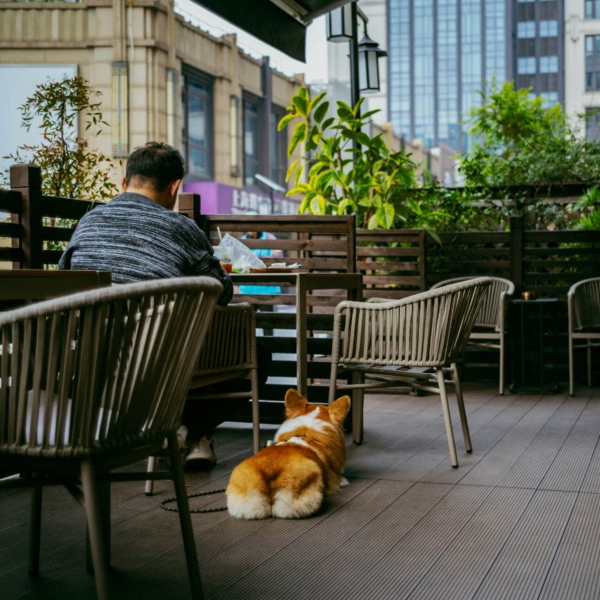

Sounds like a dog-lover’s paradise, doesn’t it? A cafe filled with precocious pooches, all fighting for attention and the chance to offer some unconditional love. But there are no furry friends in this Shoreditch coffee shop. This particular refreshment destination offers a living, breathing alternative to traditional office workspace.
Corgi Cafe is a 24-hour coffee shop that doubles up as a meeting and collaboration space. Work alone or with colleagues; pitch a killer business idea or work on your strategy; build a network of contacts or hang out with clients. When you’re a part of the Corgi crew, you get to work hard in a setting that’s conducive to success.
I think this innovative approach to shared workspace could be the start of something exciting. That’s why I wanted to dig deep into both the premise and the premises.
Corgi Cafe: Where the Only Dogs in View Are Drawn On the Wall
Let’s get this out of the way right now. You’re not going to meet any adorable corgis during a visit to this London coffee shop. It takes its name from Corgi, a San Francisco startup that sells insurance to technology startups.
Frequented by founders, investors, engineers, and techies, Corgi Cafe state-side is a place to work, meet, and run events. The first location in San Francisco earned cult-like status among the aforementioned professionals. That success led to new locations in Atlanta and New York. London’s thriving entrepreneurial spirit persuaded the company to open its first UK location. And it’s that location that serves as the company’s European “shop window”.
You’ll find this productivity hotspot on Great Eastern Street, in the Old Street area known locally as “Silicon Roundabout”. At first glance, the coffee shop looks like any other. For a start, there’s somewhere to sit. There’s somewhere to plug in your energy-hungry devices. And there’s a team of attentive staff that offers every imaginable coffee shop staple and a decent selection of cold bites. Throw in some free Wi-Fi and a large dollop of Corgi-inspired art, and you have all the ingredients for a classic coffee shop experience. And it can be yours with no minimum spend.
But at Corgi Cafe, the best thing on the menu is always opportunity.
What’s Not On the Menu at Corgi Cafe?
Insurance! Yes, this insurance company doesn’t expect anything in return for its reasonably priced hospitality. And as the founder of an office space brokerage in London, I think the concept is genius. Let’s be honest: Corgi isn’t doing this for altruistic reasons. They see an opportunity to showcase their brand and their services in a uniquely understated way. The fact that the capital’s best and brightest get somewhere to be productive and grow is a welcome by-product.
So, we know what’s not on the menu; it’s probably a good idea to address what is. The theme is very much AI- and tech-orientated. There’s a good selection of protein smoothies on offer, as well as a selection of coffee shop classics named after some of the world’s best-known AI entities. Take the ElevenLatte, for example, which is an AI-themed offering from ElevenLabs. Or if you’re in search of a caffeine hit to fuel your productivity, there’s an espresso-lime-tonic called the AI Gateway Drug
But this version of the classic coffee shop hasn’t been without its issues. The idea of this brand of “pop-up coffee shop” obviously has legs, but it’s not without its limits. In September, San Francisco’s Department of Public Health closed Corgi’s second San Francisco cafe for operating without a valid health permit. According to the SF Standard, the closure followed an Environmental Health inspection. The reason? A missing permit, of all things.
But when non-hospitality businesses learn the ins and outs of the industry, I only see good things for the future. Let me talk about why.
AI Could Be Returning London to Its 17th-Century Roots
Let’s get controversial for a moment. You see, as a leading office space broker in London, it’s my job to source workspaces. But from what I’ve been seeing recently, this kind of ground-floor public workspace is fast becoming more important than much of the office space above it. You might be shocked at my thoughts on this issue, but hear me out.
In 1652, a servant named Pasqua Rosée opened London’s first coffeehouse in St Michael’s Alley, just off Cornhill. It began as little more than a shack against a churchyard wall. Within a few decades, London was home to hundreds of similar coffeehouses. Each had its own crowd: merchants, shipowners, writers, scientists. Ideas were swapped, ventures were backed, and deals were struck over the table. Lloyd’s of London began life as one of these coffeehouses, run by Edward Lloyd on Tower Street. The authorities were so alarmed by what was being said in them that Charles II tried to shut them down in December 1675. The proclamation was revoked within days after public uproar.
Then the pub took over, along with the gentlemen’s clubs. For three centuries, work happened in the office and everything else, including a good deal of networking, happened over a pint. But pubs are now closing at an unprecedented rate. According to the British Beer and Pub Association (BBPA), the UK lost nearly 2,200 pubs between 2020 and 2025. We’re talking a pub a day.
Are London-based entrepreneurs, business professionals, and creatives returning to the 17th-century way of doing things? London coffeehouses were once the bedrock of business dealings and creative processes. Then came the pubs. There’s now strong evidence that the coffeehouses are coming back with a vengeance.
Giving AI Firms a Brick-and-Mortar Presence
So why are the coffeehouses enjoying a renaissance as places to do business? Why are AI companies the ones leading the charge? Because they are desperate to look real.
AI firms are spending serious money to develop a tangible presence in the real world. Legal AI company Harvey (named after Harvey Specter in Suits) signed Gabriel Macht, the actor who played him, as its first brand partner in February. Two months later, its rival Legora put Jude Law on outdoor advertising in New York and London under the line “Law just got more attractive”. According to the Financial Times, unprompted visits to Legora’s website jumped 900% the following month.
AI companies do most of their stuff in the ether. They’re remote. Some people find them inaccessible as a result. And when they do, building trust becomes difficult. Workspace in London and other major cities is a fairly cost-effective solution to this problem.
I’m seeing this in ADAPT’s own briefs. One London AI scale-up looking for a new office actually mentioned Corgi Cafe. It wanted a small shopfront townhouse with a coffee shop downstairs that anyone can walk into. The private office areas would be restricted to the upper floors.
Another AI company put it more bluntly. In effect, it wanted to do Corgi Cafe, but do it well. That meant a coffee shop at street level, the business on the floors above and apartments in the same building.
Neither brief opened with a desk count. Both opened with the ground floor. There’s no doubt about it. This approach is proving increasingly popular right now.
The Concept Is Catching On Across the World
Something is happening. AI companies and tech startups are beginning to see the potential in using hospitality and free office space as a promotional vehicle. Corgi, a San Francisco AI insurance startup valued at around $4bn, has opened a 24/7 cafe. Cursor has run pop-up cafes in more than 130 cities, and Granola turned its own office into a coffee shop for a user research morning.
Google Cloud has also joined the party. In October, it teamed up with Grind to host a free, drop-in Vibe Café on Royal Exchange. Visitors got a complimentary coffee, and non-technical professionals worked with Google Cloud experts to turn a business idea into a live prototype using plain English. Gemini even designed the foam art on their drinks. It’s a shop window with a flat white attached, and it needed no registration.
And we’ve seen evidence of the demand for this type of commercial space here at ADAPT headquarters. Back in 2019, before Covid, Pollinate, a fintech we had placed in London, came to us and asked us to help them find a location for a pop-up coffee shop. At the time, we couldn’t see why a fintech would want one. We just assumed it was a way of testing their data, but they told us it was about interacting with their customers face to face. We spoke to the retail agents to try to get them the coffee shop at the Royal Exchange. Google has run its own
pop-up cafe in exactly the same spot for some time now. So, what looked like an odd request from a fintech firm is actually a tried-and-tested business opportunity for one of the world’s great tech giants.
None of this is entirely new, of course. Knotel’s idea of a clubhouse serving a cluster of managed floors was a moderate success. One that springs to mind in London is located at Old Sessions House in Clerkenwell. The Grade II-listed former courthouse became a members’ workclub and an extension of the tenants’ own offices. WeWork was right about the concept too. It just built too much stock in the wrong places.
The lesson is the same one the coffeehouses taught: it is the place where people meet that matters, more than the square footage around it.
Compare that with the traditional alternative. Desks at London coworking operators typically start at around £200 a month. Corgi’s offer is a free desk for the price of a coffee, in the heart of a true hotspot for tech founders.
The Tech Community in London Is Catching On to a New Approach to Shared Workspace
CBRE’s 2026 survey found 88% of European office occupiers would reject a building lacking an amenity they consider essential, up from 82% a year earlier. And judging by the briefs landing on my desk these days, one of the latest essentials being added to the list is a ground-floor space that can be opened for public use.
The AI companies briefing us aren’t asking for less office. They want a building that doubles up as a marketing tool. It just so happens that the part of the building doing the heavy lifting sits at street level with its doors open to the public.
If you’re planning a London move and want space that works for the people you invite in as well as your own team, ADAPT will put together a free London office shortlist contact us at adaptworkspace.com, or you can email me at chris@adaptworkspace.com.